BLIND DECONVOLUTION OF THE SXT PSF CORE PART
1Space Research Centre, Polish Academy of Sciences, Solar Physics Division,
Kopernika 11, 51-622 Wroclaw, Poland
2Montana State University,
P.O. Box 173840, Bozeman, MT 59717, USA
Abstract
We explore a blind iterative deconvolution algorithm for the determination of
the core part of the point spread function of the soft X-ray telescope aboard
Yohkoh. The algorithm has been adapted and modified to deal with the
in-flight recorded X-ray images of solar flares. Particular care has been taken
to achieve good data selection and initial conditions in order to improve
the algorithm performance and convergence. We show an example of a deconvolved
point spread function core profile and compare it with ground calibration data.
THE ALGORITHM AND DATA SELECTION
We have adapted the blind iterative deconvolution (BID) algorithm (Ayers and
Dainty, 1988) to deal with data from Soft X-ray Telescope (SXT) aboard
the Yohkoh
satellite. The result obtained in Ayers and Dainty paper on synthetic data
showed that the algorithm is capable of giving good
restorations for both the deconvolved image and the point spread function (PSF).
Our, independent, tests revealed that the performance and speed of the BID algorithm
depend on the initial guess for the shape of the PSF and the quality of data.
Therefore, we
took special care in data selection and processing.
We have chosen full resolution SXT images taken in Al12 filter for our first
PSF restorations. From analysis of compact flare kernel images we came to the
conclusion that a good guess for the PSF can be provided directly from images
of X-ray compact structures observed by SXT. Trial deconvolutions showed also
that the use of compact sources accelerates the BID code convergence.
From compact structures that we had found earlier in a search
through the entire mission-long database of SXT full resolution frames
(Gburek and Sylwester, 2002), we selected the data for the year 2000,
a period relatively short in comparison with the duration of theYohkoh
mission, but long enough to ensure good coverage over the entire CCD. For
comparison
of our PSF BID restorations with SXT ground calibration data (Martens, Acton,
and Lemen, 1995) we have chosen the bx02_apr24
series of microfocus source images taken in Al-K line, which lies near maximum
of the SXT effective area curve for the Al12 filter.
The deconvolutions of the SXT PSF were performed as follows. First, for a
given calibration image, we took a sequence of Al12 compact flare images from
the same area on the CCD. Then, the initial guess for the PSF core
was made with the steepest descent method; a term by Sylwester and Gburek.
In short, this method takes an image sequence, normalizes each image
to [0,1] and co-registers them. Then it searches the entire sequence for
the lowest signal at any pixel position. The minimum values for each pixel
are collected in a new array of the original image size from the sequence.
The authors have checked that good estimates of PSF core can be obtained by
this method. The PSF estimate was then deconvolved from the most compact
flare image of the sequence and compared to the chosen calibration beam image.
The results are discussed bellow.
RESULTS AND CONCLUDING REMARKS
Tests of BID on real SXT data have revealed expected and
desirable features: in the deconvolved image there is an increase in signal
range and a separation of nearby sources. The structures in the ``clean"
images are much sharper. Sharpening is also seen in the
restored PSF. No significant deformations of the image and PSF, which may come from noise or
method artifacts, were detected during the tests. The deconvolved PSF is
still slightly more fuzzy that the calibration beam profile in Al-K line (see
Fig. 1).
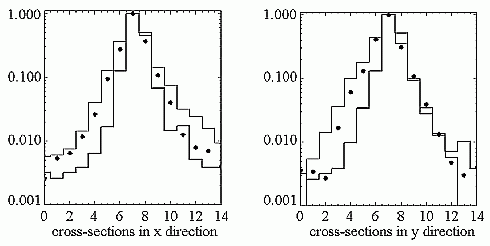
Fig. 1.
A result of blind iterative deconvolution for the SXT PSF core and its
comparison to ground calibration data is shown in cross-sections in the plots
above. Thin solid line - cross-sections of the initial PSF guess constructed by
the steepest descent method from a flare image sequence, black dots - cross-
sections of PSFs obtained from BID, thick solid line - cross-sections of the SXT
PSF from ground calibrations.
Because the observed solar radiation is
not monochromatic, one would expect some broadening of the in-orbit PSF with respect to the on
ground calibrated in monochromatic spectral lines.
In conclusion, an improvement of the morphological and
photometric properties of the SXT images can be obtained with the BID method
described above. First results show that blind deconvolution is capable of
determining the shape of the SXT PSF core in-orbit. We find close agreement
with the ground calibrated PSF.
ACKNOWLEDGMENTS
This contribution has been supported by Polish KBN grant 2.P03D.024.17 and
grant from Yohkoh 10th Anniversary Meeting organisation.
References
-
Ayers G. R., Dainty J. C., Iterative blind deconvolution method and its applications, in
Optic Letters, vol. 13, no. 7, (1988)
-
Gburek S., Sylwester J., Search for Compact X-ray Sources in SXT Observations,
Sol. Phys, in press, (2002)
-
Martens P., Acton L., Lemen J., The Point Spread Function of the Soft X-ray Telescope Aboard Yohkoh,
Sol. Phys. 157, 141, (1995).
BACK
File translated from TEX by TTH, version 2.25.
On 28 Mar 2002, 13:39.